Aerospace, medical-device, and industrial manufacturers depend on precision machining to produce reliable parts with exact dimensions and repeatable performance. CNC Lathe Machining in Dallas supports tight tolerances, stable surface finishes, and consistently repeatable production results. This controlled manufacturing approach substantially reduces corrective work, rejected components, and avoidable machine downtime. Advanced shops use a combination of multi-axis mills, precision lathes, EDM machines, waterjets, and laser-cutting equipment. This combination enables intricate components to move through production with fewer setups, less repositioning, and reduced supplier handoffs. These efficiencies shorten machining cycles and improve quality for engine hardware, aircraft landing-gear parts, and electronic housings.
Maintaining a visible local presence is increasingly valuable for Dallas manufacturers seeking customers, employees, and industry recognition. Manufacturers regularly share production images, machining footage, project summaries, and finished components through Instagram and similar platforms. The strategy generates customer interest and supports recruitment of experienced operators and technical personnel across the local CNC sector.
Real-world implementations such as Paramount Machine’s adoption of Datanomix demonstrate how Automated Production Intelligence can improve manufacturing visibility. Machine connectivity enables the system to expose real operating data, including spindle activity, downtime causes, and true utilization levels. With clearer performance information, machining companies can quote more precisely, eliminate inefficiencies, and generate stronger financial returns.
This case study provides practical information concerning equipment selection, material processing, production improvements, and measurable business results. Attention is directed toward repeatable strategies that can be introduced by machining services in Dallas and throughout the broader regional manufacturing ecosystem.
Overview Of The CNC Lathe Machining Dallas Case Study
The study reviews how CNC lathe machining in Dallas contributes to reliable, precision-focused manufacturing. Particular attention is given to sectors that depend on complex geometries, demanding dimensional limits, and consistent production results. The review considers machine selection, process controls, material-handling practices, tooling decisions, and the integration of production-monitoring technology. Together, these methods strengthen quoting, increase productive machine time, and improve operational performance. Published case studies, online process content, and client feedback demonstrate real outcomes and strengthen supplier trust.
Case Study Purpose And Coverage
This case study aims to explain how disciplined workflows lower scrap while speeding up production of high-value components. The scope includes fixture and setup techniques, quality-verification procedures, and production-data collection for ongoing optimization. Special attention is given to tracking cycle times, tooling longevity, equipment use, and material movement across both development and full-production runs.
Target Dallas Markets: Aerospace, Defense, Healthcare, Automotive, And Industry
Aircraft engine hardware, landing-gear assemblies, and avionics enclosures often depend on extremely precise machining measured at the micron level. Military and defense components require strength, complete manufacturing traceability, and documented process consistency. Healthcare components rely on approved materials, carefully managed surface conditions, and highly accurate finishing. Vehicle and industrial markets commonly focus on higher-volume manufacturing, process reliability, and cost efficiency.
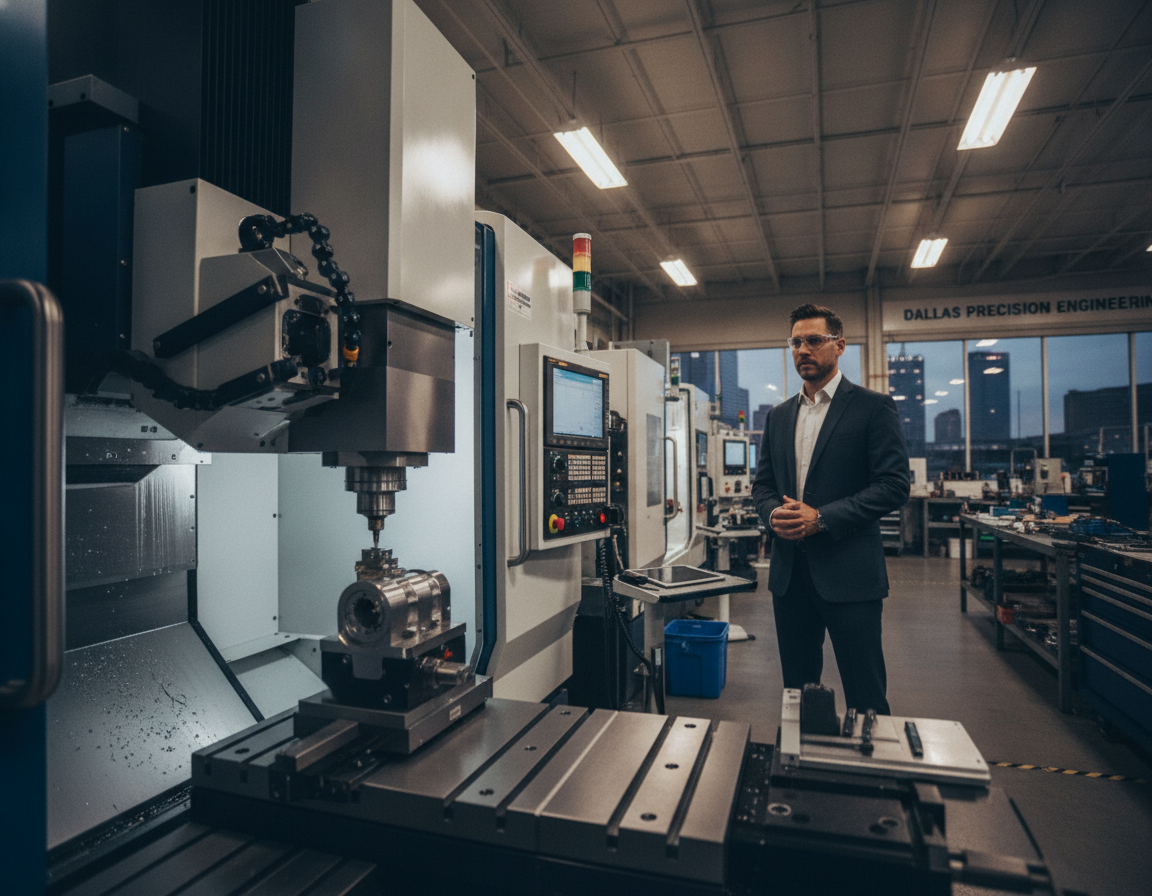 Custom Mold Services Dallas
Profile Of Lowrance Machine And Dallas CNC Machining Capabilities
Lowrance Machine provides CNC milling and lathe-machining services in Dallas while using Datanomix to improve reporting, visibility, and equipment efficiency. Its services include multi-axis production, accurate CNC turning, specialized tooling, and adaptable processes covering short development runs through long-term manufacturing.
| Technical Resource | Benefit | Typical Use |
|---|---|---|
| Advanced multi-axis machining | Reduced repositioning with improved handling of intricate shapes | Useful for aircraft enclosures and precision medical components |
| Precision CNC turning centers | Improved roundness, dimensional repeatability, and finish quality | Critical for engine parts, rotating shafts, and cylindrical components |
| Custom thread and fastener tooling | Reliable manufacturing of nonstandard fastener forms and threaded features | Useful for Dallas custom-fastener production and unique joining applications |
| Production monitoring | Live uptime, utilization, and cycle-performance analytics | Supports stronger estimates and job costing for Dallas CNC shops |
| Quality inspection stations | Inline verification, vision inspection, and CMM validation | Ensures parts satisfy demanding aviation and healthcare requirements |
| Flexible custom-production processes | Efficient transition from sample components to ongoing manufacturing | Supports scalable Dallas custom-fastener and specialty-part production |
Machining Technology And Production Resources In Dallas
Dallas machine shops use advanced mills, turning centers, inspection equipment, and skilled bench work to satisfy demanding aerospace and industrial requirements. These shops combine sophisticated CNC technology with traditional machining knowledge to handle development work, corrective repairs, and production quantities. By reviewing immediate utilization data, supervisors can distribute work more effectively and reduce equipment inactivity.
Benefits Of 5-Axis Machining For Complex Dallas Components
Advanced multi-axis machines move tools and workpieces across several directions simultaneously, reducing setups for intricate aircraft parts. Single-setup production reduces the number of fixtures while maintaining more uniform surfaces on contoured geometries. Dallas 5-axis providers can eliminate many manual steps while improving positional accuracy across complex profiles.
Dallas CNC Lathe Machining: Turning Centers, Tooling, And Tolerances
High-performance turning equipment handles demanding titanium and stainless-steel components while maintaining close dimensions. Tooling arrangements may include precision collets, hydraulic chucks, and replaceable indexable inserts configured for long runs and repeatable output. Successful CNC lathe machining in Dallas depends on thermal compensation, rigid machine construction, controlled workholding, and proactive tool-wear management.
Dallas CNC Milling And Manual Machining Integration
Dallas CNC mills create intricate cavities, precise contours, and closely spaced features with speed and repeatability. Traditional manual machining continues to support custom fixtures, single components, repair work, and small fitting corrections. Using CNC and manual processes together allows manufacturers to transition efficiently from prototype work to production without losing dimensional control. Industrial machining services in Dallas that unite automated milling with experienced manual finishing can deliver faster results for custom and low-volume projects.
Process Improvements And Production Optimization
Meaningful improvements in precision-machine shops often result from numerous carefully planned adjustments rather than a single major change. Typical changes involve better tool arrangements, updated coolant strategies, stronger workholding, and more efficient multi-axis programming. The goal is faster production with no loss of precision, repeatability, or component quality. As cycle performance improves, Dallas machine shops can complete more work while maintaining the standards required for complex jobs.
Reducing cycle time depends heavily on minimizing setups and creating more efficient toolpaths. Programmers use dynamic cutting parameters, efficient chip clearing, and coordinated operations on five-axis equipment. The result is less idle motion, fewer interruptions, and reduced operator intervention. By measuring spindle hours and downtime, planners can identify idle equipment and shift production accordingly.
Automated intelligence systems reveal current operating conditions throughout the manufacturing floor. Dashboards display actual running rates, machine stops, downtime explanations, job histories, and utilization trends. With detailed operating information, providers can refine pricing, understand job expenses, and eliminate margin-reducing inefficiencies.
Monitoring platforms help management identify repeated stoppages caused by coolant replacement, cutter wear, material shortages, or operator delays. Shops may introduce preventive tool swaps, more effective coolant strategies, and updated process controls to protect part quality. Accurate capacity and costing data supports better make-or-buy decisions for Dallas machining operations.
Machine shops now integrate error-proofing technology directly into production to identify problems early. Machine-mounted vision equipment checks component presence, orientation, and basic features during first-article approval and recurring production. Laser-based inspection tools evaluate critical profiles and dimensions prior to additional processing. Coordinate measuring machines provide final dimensional confirmation for selected production samples and completed lots.
Multiple levels of quality verification reduce rejected components and rework while supporting compliance with aviation and healthcare specifications. Consistent quality and monitoring reduce crisis maintenance while improving coordination with local machine-repair services.
Maintenance teams use monitoring data to schedule preventive work that protects machine availability and extends productive life. Trending alarms can reveal spindle imbalance, vibration changes, coolant contamination, or declining cutting performance. These signals prompt timely industrial equipment repair Dallas support or targeted component replacement. The partnership between production data and maintenance planning reduces disruption and strengthens delivery reliability.
Machining Materials, Precision Tolerances, And Specialty Parts
Machining providers in Dallas work with numerous materials used throughout aviation and general industry. Common raw stocks include 7075 and 6061 aluminum, Ti-6Al-4V titanium, alloy steels, stainless grades, and advanced composite laminates. Every material requires carefully selected tools, cutting parameters, workholding, and coolant methods to manage heat, abrasion, and dimensional movement.
Aluminum machining commonly uses high-feed cutters, polished flutes, and positive-rake geometries that promote efficient chip removal. Machining titanium calls for conservative cutting loads, secure workholding, rigid equipment, and durable coatings including TiCN. Composite materials need specialized drills, controlled feeds, dust extraction, and vacuum clamping to minimize fiber damage and delamination. These material-specific techniques are important for CNC lathe machining Dallas projects requiring stable finishes and repeatable dimensions.
Close-tolerance aircraft components depend on environmental stability, reliable workholding, and carefully validated machine setups. Precision turning centers equipped with thermal compensation can provide micron-level repeatability when combined with in-process probing and routine calibration. Quality protocols use CMM measurement, laser inspection, calibrated gauges, and SPC analysis to detect dimensional drift.
Precision fixtures and multi-station workholding reduce handling variation and improve cycle stability across production runs. Industrial machining providers in Dallas feed measurement information back into production to identify changes before defective quantities accumulate. This strategy reduces rework while supporting reliable delivery of components used in safety-critical aircraft systems.
Specialized Dallas production often includes custom fasteners, bronze or steel inserts, threaded components, and mold tooling. A custom fastener manufacturer Dallas operation may combine turning, heading, thread production, heat treatment, coating, and final inspection. Such manufacturing controls allow fasteners to meet demanding aerospace expectations for durability and documented conformity. Machined inserts require exact shoulders, threads, and press-fit dimensions for dependable use in aluminum or composite structures.
Successful mold inserts depend on smooth surfaces, consistent dimensions, and highly accurate form. Rotational sections are commonly produced on CNC lathes, while mills and EDM systems complete detailed mold geometry. Monitoring job performance enables shops to quote specialty work realistically and deliver it within practical timeframes.
| Machined Component | Common Material | Typical Production Sequence | Target Tolerance |
|---|---|---|---|
| Precision engine spindle | Ti-6Al-4V titanium | CNC lathe machining, thermal processing, finish grinding, and coordinate measurement | Approximately ±0.005 mm |
| Aircraft landing-gear bushing | Aerospace 7075-T6 aluminum alloy | Lathe production followed by reaming, anodize treatment, and operational inspection | ±0.02 mm |
| Aircraft electronics housing | Heat-treated 6061-T6 aluminum alloy | CNC milling, secondary turning, edge finishing, and pressure verification | Approximately ±0.05 mm |
| Made-to-order precision fastener | Alloy steel | Fastener forming, precision lathe work, thermal hardening, and protective finishing | Approximately ±0.03 mm |
| Machined threaded insert | Bronze alloy or stainless material | Precision lathe finishing, threaded-feature machining, and installation-fit verification | ±0.04 mm |
| Mold insert | Hardenable H13 tooling steel | EDM shaping followed by machining, finishing, polishing, and dimensional validation | A precision tolerance of ±0.01 mm |
When designers and shop-floor specialists work together, projects progress more quickly with fewer costly changes. Lowrance Machine and comparable Dallas providers illustrate how integrated manufacturing capabilities can produce specialty components at meaningful scale. The integrated approach helps Dallas industrial machine shops remain commercially competitive without sacrificing aviation-grade precision.
How CNC Turning Supports Custom Molds And Precision Inserts
Dallas mold manufacturing frequently depends on the precision and repeatability provided by CNC lathe operations. Accurate CNC turning and milling establish the cavities, cores, sleeves, and mold inserts Dallas companies require. Accurate machining ensures mold components fit correctly and produce stable results throughout repeated molding cycles.
Dallas Custom Mold Services: Production Capabilities And Process
Regional suppliers rely on CAM software and advanced machining centers for challenging mold forms. Technical teams create precise cutting programs, design specialized workholding, and perform high-speed finishing to meet required textures and finishes. Electrical-discharge machining completes fine details and inaccessible geometry beyond the capabilities of ordinary milling tools.
Tooling choices, fixture accuracy, process control, and ongoing inspection work together to preserve consistency. These controls allow custom mold services Dallas providers to maintain uniform cavity geometry and accurate bore concentricity during demanding production cycles.
Dallas Injection, Rubber, And Industrial Mold Production
Reliable injection tooling begins with carefully controlled cavities, runners, gates, and mating surfaces. Precision lathe machining creates round mold components with controlled diameters, concentricity, and true-running surfaces. Dallas rubber-mold applications depend on controlled draft and polished surfaces that reduce excess material and cleanup.
Industrial molds Dallas programs often involve larger tools, substantial plates, and stronger wear-resistant alloys. Initial geometry is produced through turning and milling, followed by polishing and other finishing processes to meet tolerance and texture requirements.
Mold Builder Relationships And CNC-Turned Mold Components
Partnerships between mold designers and machine shops help transform theoretical geometry into reliable production tooling. CNC lathes manufacture threaded inserts, core components, concentric bores, and stepped features that fit correctly within mold assemblies.
Past job data and real-time utilization reports help tooling companies estimate production time, determine pricing, and coordinate preventive service. Better planning reduces lead times while helping finished molded parts fit downstream assemblies correctly.
| Component | Typical Process Steps | Quality Check |
|---|---|---|
| Precision injection-tool cavity block | Three-axis roughing, five-axis finishing, and EDM detailing | Coordinate measurement combined with finish and contour analysis |
| Core pin or sleeve | Swiss turning or CNC lathe machining, heat treatment, and final grinding | Runout measurement, diameter verification, and hardness testing |
| Precision insert used in an overmold tool | Multi-axis milling, precision turning, and controlled polishing | Surface inspection with representative dimensional verification |
| Rubber-tooling pattern or template | Initial tooling build, CNC refinement, and specified texture treatment | Tear-strength testing and dimensional verification |
| Precision plate for industrial tooling | Milling and slotting followed by stress reduction and final flatness finishing | Granite-table verification of flatness, thickness, and parallel alignment |
Operational Reliability Through Maintenance And Repair
Machine reliability directly affects part quality, customer confidence, and the commercial performance of a precision shop. Routine thermal verification, spindle-health monitoring, bearing analysis, lubrication checks, and tool-life tracking help preserve equipment condition. Ongoing machine care helps ensure critical components continue to satisfy strict dimensional and surface requirements.
Dallas shops often use both in-house technicians and certified repair specialists to resolve equipment problems quickly. Qualified repair technicians handle problems involving hydraulics, motors, servos, electrical circuits, and machine-control systems. Effective planning of technicians, spare components, and available service windows shortens equipment recovery time.
Preventive maintenance can significantly improve the reliability of machining services Dallas operations. Inspection logs may include coolant tests, spindle vibration, oil condition, calibration history, and replaced machine components. Consistent records prevent avoidable interruptions and demonstrate controlled maintenance to customers and auditors.
Real-time intelligence can reveal underperforming machines early enough for corrective action. Dashboards alert operators to slower cycles, increased idle time, abnormal loads, and accelerating tool wear. The technology accelerates fault investigation and removes much of the labor associated with collecting machine-performance data.
Real-world results reveal that targeted fixes often produce rapid improvements in machine availability. A line may recover during one work shift after technicians change worn bearings, revise offsets, tune cutting parameters, or correct coolant problems. Dallas machine-repair suppliers can provide important replacement components that shorten equipment outages.
Resilient manufacturing depends on capable employees, clear procedures, and ready access to replacement components. Employees trained across multiple systems, supported by written service procedures and critical-parts inventories, can respond more effectively. Reliable recovery processes reassure buyers that unexpected equipment issues will not automatically prevent on-time delivery.
Case Study Results: Performance, Profitability, And Customer Impact
Following improvements in workflow and analytics, the facility experienced stronger manufacturing and business performance. Measures such as cycle time, scrap percentage, first-pass yield, utilization, and on-time delivery demonstrate the relationship between process optimization and increased throughput in machining services Dallas operations.
Key Results In Cycle Time, Scrap, Yield, And On-Time Delivery
The use of advanced setups and better tooling shortened production by reducing repeated handling and secondary machining. More stable fixtures combined with vision-based checks prevented errors and reduced wasted components. These changes increased first-pass yield for precision products used in medical and aerospace applications.
On-time delivery improved as shops used historical job records and live operating data to anticipate production bottlenecks. More dependable schedules allowed buyers to place important orders with Dallas CNC shops with greater assurance.
Data-Driven Pricing, Quoting Accuracy, And Profitability
Reliable historical job information enabled managers to prepare more accurate estimates and allocate labor, tooling, and machine time more effectively. Understanding true machine utilization Dallas figures reduced idle periods and allowed preventive maintenance to be scheduled during lower-demand windows.
Dallas machining margins improved after quotations reflected real production time, staffing, tool wear, and operating expense. Evidence-based pricing allowed providers to remain attractive to buyers while protecting financial returns. Consistent performance and realistic pricing helped generate recurring business in military and industrial sectors.
Customer Outcomes For Precision Components And Custom Fasteners
Buyers of Dallas custom fasteners and machined casting inserts benefited from faster completion and improved part-to-part consistency. The reliability of these components encouraged longer agreements and stronger supplier relationships with regional manufacturers.
Precision components delivered according to schedule helped OEMs avoid disruptions to assembly, maintenance, and final-product completion. The combined gains reinforced the importance of dependable Dallas CNC suppliers to nearby manufacturing networks.
Conclusion
The findings show how Dallas CNC lathe machining supports demanding applications across aviation, healthcare, vehicle, and industrial markets. Multi-axis turning, modern tooling, stable workholding, and controlled tolerance processes enable suppliers to produce parts that satisfy strict specifications. Integrating Dallas CNC milling with experienced manual work ensures machined products are fully finished and prepared for their intended application.
Introducing real-time manufacturing intelligence strengthens job costing, capacity planning, and machine-performance visibility. These improvements reduce idle time and unplanned downtime, contributing to stronger profitability and increased customer loyalty. Dallas machining services using data-driven processes consistently report shorter cycles, lower scrap, and improved resource utilization.
Knowledge of difficult materials, custom mold production, and accurate tooling inserts gives Dallas suppliers an additional market advantage. Comprehensive maintenance and inspection programs remain essential for protecting output, accuracy, and delivery commitments. The combined model enables Dallas industrial machine shops to satisfy strict requirements and expand their businesses through stronger performance and dependable service.